01→
Observe
Combine visual, spatial, temporal, environmental and human-provided signals.
Sinuosity Physical Intelligence Lab
Sinuosity develops multimodal models and autonomous systems that perceive, reason and operate in complex real-world environments. We begin in agriculture, where variability, constrained connectivity and consequential decisions demand a more rigorous form of intelligence.
Our research thesis
AI systems have become increasingly capable in language, code and other digital domains. Physical environments remain harder. Conditions change continuously. Sensors provide incomplete information. Hardware imposes strict constraints. Actions can damage equipment, crops or surrounding environments.
We research the models and systems required for AI to understand these conditions, act under uncertainty and improve through real-world experience.
Combine visual, spatial, temporal, environmental and human-provided signals.
Represent objects, conditions, relationships, changes and uncertainty.
Choose the next observation or action under operational and safety constraints.
Connect high-level intelligence to deterministic control systems and human oversight.
Improve from outcomes, corrections, interventions and repeated field experience.
Research
Multimodal models that represent crops, terrain, field conditions and change over time using ground imagery, video, geospatial information, weather, metadata and human observations.
Learning systems that connect perception and reasoning to physical action, beginning with agricultural machines operating in unstructured outdoor environments.
Efficient models and runtimes designed to operate locally where bandwidth, latency, power, privacy or reliability make continuous cloud access unsuitable.
Speech and language systems that support natural interaction with scientific and physical-intelligence systems, beginning with Twi, Ghanaian English and real-world code-switching.
Evaluation methods for determining whether intelligent systems remain reliable, calibrated and safe outside controlled demonstrations.
Applied intelligence / Introducing FAMA
Meet FAMA, Okuafo’s compact handheld for crop intelligence. A rear camera, a speaker and three tactile controls bring an offline-first, audio-first approach closer to the farmer.

Models and systems
Sinuosity develops research models, evaluation frameworks and experimental platforms together. Models are studied through data-collection and field systems rather than evaluated only on static laboratory datasets.
Every record below states its current lifecycle and evidence basis. No item is presented as an open release unless access is explicitly published.
Calibrated two-model maize symptom screening system
A public development candidate combining categorical and specialist FP16 TensorFlow Lite models with locked fusion calibration and explicit abstention for offline, human-reviewed maize-leaf symptom screening.
Two-stage offline maize screening system
A research-preview, two-stage LiteRT and TensorFlow Lite vision system evaluated on documented development datasets and limited field samples for offline, human-reviewed maize-leaf screening.
Multimodal field foundation model
FieldMind-1 is a family of multimodal models being developed to understand agricultural environments across images, video, metadata, location and time.
Embodied agricultural policy model
FieldAction-1 investigates how agricultural machines can learn useful field behaviors from teleoperation, demonstrations, interventions, failures and experience across platforms.
Low-resource speech and voice model family
TwiField Speech investigates speech recognition and generation for Asante Twi, Akuapem Twi, Ghanaian English and agricultural code-switching.
Real-world physical-intelligence evaluation framework
FieldBench is being designed to evaluate autonomous and multimodal systems under real agricultural operating conditions.
Experimental field-intelligence platform
Farmba Scout is a modular agricultural rover prototype used to study field data collection, perception, teleoperation-to-autonomy and offline physical-intelligence workflows.
Technical system
Reference research architecture · illustrative
Initial proving ground
Agricultural environments expose many of the central problems of physical intelligence at once. Biological systems change over time. Symptoms may have multiple causes. Fields differ by soil, crop, weather, management practices and camera conditions. Connectivity is not guaranteed, and incorrect decisions can carry real financial and environmental costs.
A system that performs reliably under these conditions must do more than recognize an image. It must integrate context, represent uncertainty, request better evidence, operate efficiently and learn from what happens after a decision is made.
Our agricultural work is both an applied mission and a rigorous research environment for developing intelligence that can eventually extend to other outdoor and industrial domains.
Data and learning
The central research asset is not a collection of disconnected photographs. It is a longitudinal record connecting observation, interpretation, action and outcome.
Field imagery, sensor readings and human reports.
Visible evidence, candidate explanations and uncertainty.
Inspection, treatment, human intervention or machine behavior.
Subsequent field condition, recovery, failure, yield and cost.
Data collection must be consented, provenance-aware and governed according to clear internal, research and public-release permissions.
Read our data governance approachOpen research
Sinuosity releases selected model artifacts, evaluation tools, reference implementations, technical reports and carefully governed datasets where public access can accelerate progress without compromising privacy, rights, safety or evaluation integrity.
Dataset release / 002
Ten public Hugging Face dataset repositories for Ghana agricultural data, with registry, provenance, governance, redistributable crop-statistics payloads where allowed and GhanaAgBench benchmark assets.
Public access does not imply a blanket open-source license grant. Review each repository license, source receipt and limitation before reuse.
Safety
Models operating in physical environments must be evaluated differently from ordinary software. Sinuosity studies layered safeguards spanning model behavior, deterministic control, hardware limits, human oversight and operational procedures.
Understanding instructions, restrictions and unsafe requests.
Uncertainty calibration, abstention and human approval.
Deterministic motion limits, geofencing and emergency stopping.
Training, maintenance, permissions and incident procedures.
Independent testing, private benchmarks and failure reporting.
Research register
Field vision / calibrated screening
A public development candidate for human-reviewed maize symptom screening, combining categorical and specialist FP16 TFLite models through a locked calibrator with explicit abstention.
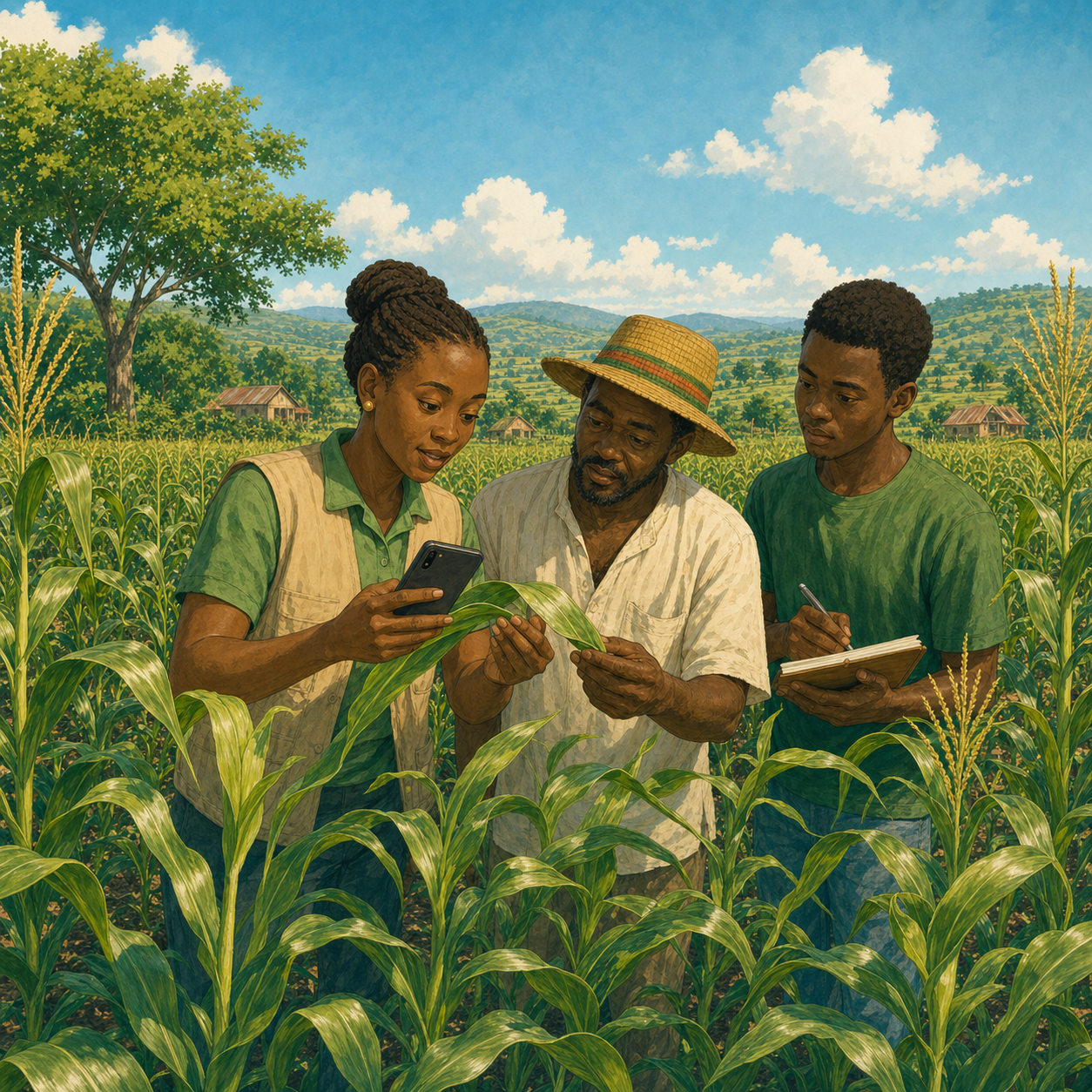
Published for user testing with a known gray leaf spot recall limitation. It is not independently or agronomist validated and is not approved for production or autonomous diagnosis.
Collaboration
We collaborate with researchers, universities, farms, equipment manufacturers, scientific institutions and technology partners working on difficult physical-world intelligence problems.
Joint studies, graduate research, benchmarks and publications.
Field sites, longitudinal data and operational evaluation.
Hardware integration, autonomy and cross-platform learning.
Cloud infrastructure, edge hardware, sensors and developer tools.
Agronomy, plant pathology, soil science, remote sensing and linguistics.